
July 2026 GCC Tax Update: Key Regulatory Developments Across the Region
Tax policy across the GCC continued to progress throughout June 2026, with governments introducing a range of legislative and administrative measures designed to strengthen compliance, enhance tax certainty, and further align domestic tax systems with international standards. This month’s developments span corporate taxation, indirect tax, customs, real estate, and international tax cooperation, reflecting the region’s continued focus on building a more transparent and efficient tax environment.
A key development was the issuance of UAE Ministerial Decision No. 96 of 2026, through which the Ministry of Finance formally adopted the 2026 OECD Consolidated Commentary and Administrative Guidance on the GloBE Model Rules as the official interpretative framework for the UAE’s Domestic Minimum Top-Up Tax regime. The Decision replaces Ministerial Decision No. 88 of 2025 and applies retrospectively to fiscal years commencing on or after 1 January 2025, making it important for multinational enterprise (MNE) groups to review their existing Pillar Two calculations and compliance positions against the updated OECD guidance.
Across the indirect tax landscape, Saudi Arabia approved amendments to the GCC Unified VAT Agreement, introducing revisions covering the VAT treatment of intra-GCC movements of goods, cross-border B2C transactions, import VAT settlement procedures, and enhanced cooperation through information sharing between GCC tax authorities. At the same time, Qatar’s General Tax Authority published a consolidated Withholding Tax Guide and introduced detailed implementation guidance for its new
Tiered Volumetric Excise Tax on sweetened beverages, which came into effect on 6 July 2026.
Regulatory activity within the real estate sector also remained significant. In Saudi Arabia, the Zakat, Tax and Customs Authority (ZATCA) released Version 6 of the Real Estate Transaction Tax (RETT) Guideline, while the Ministry of Municipalities and Housing introduced implementing regulations governing fees applicable to vacant real estate. These initiatives provide additional clarity for taxpayers while supporting broader policy objectives relating to land utilisation and market development.
Elsewhere in the region, Oman established its Artificial Intelligence Special Zone under Royal Decree No. 50 of 2026, creating a new investment framework for technology-focused businesses and raising practical considerations regarding the interaction between investment incentives and the country’s Qualified Domestic Minimum Top-Up Tax (QDMTT). In the UAE, the Federal Tax Authority updated its Family Foundations Corporate Tax Guide, while Dubai Customs introduced a temporary instalment facility for outstanding customs duties as part of the Government of Dubai’s economic support measures.
International tax cooperation also continued to expand. The Double Taxation Treaty between the UAE and Monaco entered into force on 12 June 2026 and will apply from 1 January 2027, further strengthening the UAE’s treaty network and providing additional certainty for cross-border investment and international business activities.
Beyond legislative developments, the second quarter of 2026 also saw the publication of sector-focused insights covering developments affecting the financial services, healthcare, pharmaceutical, and life sciences industries. During the month, specialised technical sessions on UAE Corporate Tax Return compliance and Saudi Arabian Transfer Pricing were also conducted, bringing together professionals to discuss practical implementation challenges and emerging regulatory expectations.
As the GCC continues to refine its tax framework, businesses should remain proactive in monitoring regulatory developments and assessing how these changes may influence their compliance obligations, reporting processes, and overall tax strategy. The pace of reform across the region highlights the increasing importance of robust governance, early planning, and continuous readiness in an evolving tax environment.
 Qatar Introduces Detailed Guidance for Its New Sugar-Based Excise Tax Framework:
The Qatar General Tax Authority (GTA) has released comprehensive guidance outlining the implementation of the Tiered Volumetric Excise Tax Model for Sweetened Drinks, which became effective on 6 July 2026. The guidance provides businesses with greater clarity on the operation of the new regime and the compliance obligations associated with it.
The revised framework represents a fundamental change in the way excise tax is calculated on sweetened beverages. Unlike the previous system, where tax was determined using a fixed percentage of the retail selling price, the new approach bases the excise liability on the sugar content of the product and applies tax on a per-litre basis. This shift is intended to create a more health-focused taxation model by linking the tax burden directly to the level of added sugar contained in beverages.
The scope of the regime is broad and captures a wide range of products intended for consumption as drinks. This includes ready-to-drink beverages as well as concentrates, powders, syrups, gels, extracts, and similar products that can be prepared as beverages. Products are categorised according to the amount of total sugar contained in every 100 millilitres, with separate classifications for beverages containing low, medium, and high levels of sugar, as well as products that contain artificial sweeteners without added sugar.
One notable change under the revised rules is the removal of carbonated drinks as a standalone category of excise goods. Instead, carbonated beverages will now be taxed according to their sugar profile under the new classification system. Conversely, beverages containing only naturally occurring sugars, without any added sugar or sweeteners, fall outside the scope of the regime. Certain products also remain exempt, including qualifying 100% fruit and vegetable juices, specified milk and dairy products, infant formula, and designated medical nutrition products.
From a compliance perspective, the guidance introduces several important administrative requirements. Businesses will be required to register applicable products regardless of production volume, as no minimum registration threshold has been established. Product registration must be supported by nutritional information together with laboratory test reports issued by laboratories accredited by the GTA. Where sufficient evidence is not available, products may initially be treated as high-sugar beverages until the appropriate documentation is submitted to support a different classification.
The guidance also includes transitional provisions for businesses holding inventory before the new regime took effect. Entities with significant quantities of qualifying sweetened drinks in stock as of 31 December 2025 may be required to submit a one-time transitional declaration and account for any applicable excise tax within the prescribed timeframe following implementation.
The introduction of this new model represents a significant evolution in Qatar’s excise tax framework. Businesses involved in the manufacture, import, or distribution of sweetened beverages should review their product portfolios, verify product classifications, assess inventory positions, and ensure that supporting documentation and compliance procedures are aligned with the new requirements. For many taxpayers, the revised methodology may result in a more favourable tax outcome depending on the sugar composition of their products, although the overall impact will vary according to individual product mixes and business operations.

Saudi Arabia Updates Real Estate Transaction Tax (RETT) Guidance:
The Zakat, Tax and Customs Authority (ZATCA) has published Version 6 of its Detailed Real Estate Transaction Tax (RETT) Guideline, providing the most comprehensive interpretation of the Kingdom’s RETT framework since the introduction of the new RETT Law (Royal Decree No. 84/M), which came into effect in April 2025.
While the updated Guideline does not introduce new legislation or amend the existing RETT Law or its Implementing Regulations, it consolidates ZATCA’s latest administrative interpretation and offers greater clarity on the practical application of the rules across a broad range of real estate transactions. The Guideline also confirms that any future revisions will apply prospectively, providing taxpayers with greater certainty for completed transactions.
Among the most significant clarifications are the rules governing indirect transfers of real estate through corporate ownership structures. RETT generally applies where both the ownership interest transferred and the resulting ownership reach or exceed 30%. In addition, a cumulative three-year lookback rule has been introduced to prevent the fragmentation of transactions intended to remain below the taxable threshold.
The updated guidance also provides welcome certainty for capital increase transactions. Where ownership percentages remain unchanged, or where new investors retain their ownership interests for at least five years, the transaction will generally not trigger RETT. This clarification is particularly relevant for investment funds, joint ventures, and corporate restructuring exercises.
For Islamic financing arrangements, ZATCA has reaffirmed that structures such as Murabaha financing and finance leases are intended to be taxed only once. The subsequent transfer of legal title back to the customer under these arrangements will not be treated as a separate taxable transaction, reinforcing the principle of avoiding multiple taxation on the same underlying asset.
The Guideline further distinguishes between subdivision and partition of real estate. While the subdivision of land generally falls outside the scope of RETT, a partition may be taxable unless specific conditions are satisfied, including the absence of any change in ownership percentages, a single title deed, and no financial consideration exchanged between co-owners.
Additional guidance has been provided for Build-Own-Operate-Transfer (BOOT) projects, confirming that fair market value should be determined at the date ownership is actually transferred rather than the contract execution date.
Version 6 also consolidates more than 26 exemption categories, covering transactions such as transfers between qualifying relatives, transfers involving Waqf entities, debt settlement arrangements, transfers between spouses, government expropriations, contributions to qualifying real estate investment funds, and certain off-plan property transactions undertaken by developers.
From a valuation perspective, ZATCA reiterates that the taxable value cannot be lower than the fair market value of the property. Where the agreed transaction price is below fair market value, RETT will generally be calculated based on the higher market value. Financing components, including profit margins arising under Islamic financing arrangements, remain excluded from the taxable base.
The updated Guideline also consolidates procedural rules relating to payment obligations, penalties, and dispute resolution. It confirms the application of late payment penalties, establishes the timeframes available to ZATCA for reviewing valuations and conducting assessments, and provides clearer guidance on objection procedures. Furthermore, payment deadlines have been clarified for various transaction types, including notarised sales, transfers of company interests, usufruct arrangements, off-plan developments, and public auction sales.
The publication of Version 6 represents an important step in enhancing certainty around Saudi Arabia’s real estate taxation framework. Businesses, investors, developers, and property owners should review the updated guidance carefully to ensure that transaction structures, valuations, and compliance procedures remain aligned with ZATCA’s latest administrative interpretation.
 ZATCA Extends Tax Penalty Amnesty Until 31 December 2026:
Saudi Arabia’s Zakat, Tax and Customs Authority (ZATCA) has extended its Tax Penalty Amnesty Initiative for an additional six months, with the relief period now running until 31 December 2026. Originally introduced in 2022 to encourage voluntary compliance, the initiative continues to provide businesses with an opportunity to regularize their tax affairs while reducing the financial burden of historical penalties.
The amnesty covers a broad range of administrative penalties, including fines for late tax registration, delayed tax return filings, late payment of taxes, VAT return corrections, and certain e-invoicing violations. The initiative applies across various tax regimes administered by ZATCA, provided taxpayers satisfy the prescribed eligibility requirements.
To benefit from the relief, taxpayers must be properly registered with ZATCA, submit all outstanding tax returns, and settle the principal tax liabilities associated with those returns. Businesses that are unable to pay the outstanding amount in full may apply for an approved installment payment plan during the initiative period. However, strict adherence to the agreed payment schedule is essential, as failure to comply may result in the loss of the amnesty benefits.
It is important to note that the initiative does not extend to penalties arising from tax evasion, fines that have already been paid, or obligations relating to tax returns due after 30 June 2026. ZATCA has also clarified that even if the initiative is extended again in the future, returns with filing deadlines after this date will remain outside the scope of the current relief framework.
For businesses with outstanding tax obligations, this extension provides a valuable opportunity to resolve historical compliance issues, correct previous VAT filings, and settle unpaid tax liabilities without incurring significant administrative penalties. Companies operating in Saudi Arabia should review their compliance position promptly and take the necessary steps before the 31 December 2026 deadline to maximize the available relief.
 Oman’s AI Special Zone: A New Chapter for Innovation and Investment:
Oman has taken a significant step towards strengthening its digital economy with the establishment of the Artificial Intelligence (AI) Special Zone under Royal Decree No. 50 of 2026. The initiative supports the country’s Vision 2040 strategy by creating a dedicated environment to foster AI innovation, attract global technology investments, and encourage the growth of knowledge-based industries.
The AI Special Zone will operate within Oman’s existing Special Economic Zones and Free Zones framework, offering an attractive platform for businesses involved in artificial intelligence, digital technologies, research, cloud infrastructure, and emerging technologies. Although the detailed eligibility requirements are yet to be announced, the initiative is expected to appeal to startups, multinational technology companies, research institutions, and foreign investors seeking to expand their presence in the region.
Beyond its innovation objectives, the new zone may provide several investment incentives commonly available within Oman’s special economic zones, including:
- Corporate income tax exemptions for qualifying projects for extended periods
- Customs duty exemptions on eligible imports and exports
- 100% foreign ownership opportunities
- Relaxed capital requirements
- Simplified licensing procedures through a single-window approval process
- Long-term land use and investment rights
One of the most notable aspects of this development is that it represents one of the GCC’s first dedicated AI-focused special economic zones, positioning Oman as an emerging destination for technology-driven investments and digital transformation.
Businesses should also consider the interaction between these incentives and Oman’s Qualified Domestic Minimum Top-up Tax (QDMTT) regime. Multinational enterprises falling within the scope of the OECD Pillar Two rules should carefully evaluate how available tax incentives may affect their global minimum tax position and overall investment strategy.
As additional implementation guidance becomes available, businesses considering operations in Oman should proactively assess the commercial, regulatory, and tax implications of establishing a presence within the AI Special Zone. Early planning will be key to maximising available incentives while ensuring alignment with evolving international tax requirements.
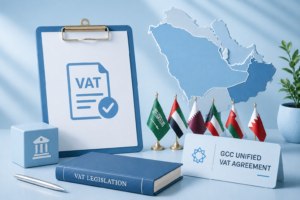 KSA Approves Amendments to the GCC Unified VAT Agreement:
Saudi Arabia has approved important amendments to the GCC Unified VAT Agreement through Council of Ministers Decision No. 887, reinforcing regional cooperation and further aligning VAT administration across GCC member states. The updated framework aims to enhance the management of cross-border transactions, improve tax coordination, and create greater consistency in the application of VAT throughout the region.
Originally adopted as the foundation for VAT implementation across the GCC, the Agreement continues to evolve in response to the growing volume and complexity of regional trade. The latest amendments focus on improving tax collection mechanisms while supporting a more efficient and transparent VAT system.
Some of the key developments include:
- Greater clarity for intra-GCC movement of goods: VAT will generally be applied based on the destination principle, ensuring that tax is collected in the country where goods are ultimately consumed. New settlement mechanisms are intended to minimise double taxation and reduce VAT leakage.
- Cross-border B2C transactions: A threshold has been introduced for supplies made to individuals and non-registered customers within the GCC. Where qualifying transactions exceed the prescribed limit, member states will be able to recover VAT through agreed intergovernmental procedures.
- Confirmation of the regional VAT framework: The amendments reaffirm that GCC member states must maintain a standard VAT rate of at least 5%, while preserving each country’s ability to apply higher standard rates or utilise zero-rating and exemptions where permitted under the Agreement.
- Enhanced import VAT procedures: The revised rules provide a more streamlined mechanism for allocating import VAT to the country of final destination. They also allow member states to introduce import VAT deferral arrangements, enabling eligible businesses to account for VAT through their tax returns instead of making immediate payments at customs, thereby improving cash flow.
- Expanded information sharing between tax authorities: GCC tax administrations will have broader access to data relating to cross-border transactions, strengthening compliance monitoring, supporting audit activities, and helping combat tax evasion across the region.
Although many of these amendments primarily affect government-to-government settlement mechanisms, businesses involved in cross-border trade within the GCC should closely monitor future implementation guidance issued by individual member states. As tax authorities increase cooperation and exchange transactional data, businesses should ensure that their VAT reporting, documentation, and cross-border compliance processes remain accurate, consistent, and aligned across all GCC jurisdictions.
 UAE FTA Updates Corporate Tax Guidance for Family Foundations:
The UAE Federal Tax Authority (FTA) has released an updated Family Foundations Corporate Tax Guide, introducing a number of clarifications that provide greater certainty for family wealth structures operating under the UAE Corporate Tax regime. The revisions expand on existing guidance and reflect the growing interaction between Family Foundations, Free Zone entities, trusts, and corporate tax rules.
One of the key additions is the inclusion of references to the UAE’s Free Zone Corporate Tax regime. The updated guide explains how Family Foundations that own or interact with Free Zone entities, including family office service companies, should assess their tax position. It also highlights circumstances in which qualifying Free Zone entities may continue to benefit from the 0% Corporate Tax rate on eligible income.
The FTA has also clarified that a Limited Liability Company (LLC) does not automatically qualify as a Family Foundation, even if it is established to manage family assets. However, an LLC may still qualify for fiscally transparent treatment where it is wholly owned and appropriately controlled by an eligible Family Foundation and all relevant conditions are met.
Further guidance has been provided for multi-tier ownership structures, confirming that subsidiary entities and special purpose vehicles (SPVs) owned by a qualifying Family Foundation may also benefit from transparent tax treatment where the required ownership and control criteria are satisfied. The guide also offers welcome clarification for trust structures, explaining how certain unincorporated trusts may continue to meet transparency requirements despite legal ownership resting with a trustee.
Another important update addresses joint ownership arrangements, confirming that a legal entity may be wholly owned by more than one qualifying Family Foundation. This provides additional flexibility for family branch structures and jointly held investment vehicles, although the assessment of control remains a separate requirement when determining eligibility for tax transparency.
The revised guidance also clarifies that certain foreign unincorporated partnerships falling within the scope of the Corporate Tax Law may not be required to register for UAE Corporate Tax, potentially providing greater certainty for qualifying offshore trust arrangements.
In addition, the guide introduces practical guidance on asset transfers into Family Foundations, distinguishing between transfers that generally remain outside the scope of Corporate Tax—such as personal investments and real estate held by individuals—and transfers involving taxable persons, related parties, or business assets, which may require a more detailed tax analysis.
The FTA further confirms that where an entity enters or exits a Family Foundation structure, a change in its tax transparency status alone will not automatically reset the tax base cost of its assets, providing greater continuity in tax treatment during restructuring.
Finally, the updated guide includes a dedicated section on family offices, noting that although they may be owned by a Family Foundation, they are generally unlikely to qualify for fiscally transparent treatment if they carry out commercial activities or generate service-related income.
Overall, the revised guidance provides greater clarity on the Corporate Tax treatment of Family Foundations and related structures. Families, private wealth groups, and advisers should review their ownership arrangements, governance structures, and operating models to ensure they remain aligned with the latest FTA guidance and Corporate Tax requirements.
 Qatar GTA Publishes Comprehensive Withholding Tax Guide and FAQs:
Qatar’s General Tax Authority (GTA) has released a comprehensive Withholding Tax (WHT) Guide and Frequently Asked Questions (FAQ), bringing together practical guidance on the application of the country’s withholding tax rules under the Income Tax Law No. 24 of 2018 and its Executive Regulations. The publication provides greater clarity on several areas that have historically created uncertainty for businesses making payments to non-residents.
Under Qatar’s current tax framework, a 5% withholding tax generally applies to gross payments made to non-residents for royalties, interest, commissions, and service fees. While the legislation has remained relatively straightforward, the new guidance offers detailed explanations on how these rules should be applied in various commercial scenarios.
One of the key clarifications relates to the concept of services being “used, consumed, or benefited from” in Qatar. The GTA confirms that withholding tax may apply where the outcome of a service supports or enhances a business operating in Qatar, regardless of where the service is physically performed. The guidance also explains that certain costs, such as accommodation and travel expenses paid directly by a Qatari business on behalf of a foreign service provider, may also fall within the scope of withholding tax unless they represent genuine reimbursements of actual costs that are incidental to the primary service.
The Guide also addresses mixed contracts involving both goods and services. Where contract values are clearly allocated between the two, withholding tax generally applies only to the service component. However, if the values cannot be separately identified, the entire contract amount may become subject to withholding tax, highlighting the importance of clear contractual drafting and invoicing practices.
Further clarification has been provided on the gross-up mechanism, confirming that where the payer bears the withholding tax, the effective tax rate increases to 5.26%, and the additional tax cost is generally not deductible for income tax purposes.
The guidance also explains the treatment of payments involving non-residents with a Permanent Establishment (PE) in Qatar. In certain circumstances, payments made directly to a foreign head office may not attract withholding tax, provided the income is properly allocated to the Qatar PE and taxed accordingly. Similarly, payments made to non-residents holding a valid GTA tax card are generally outside the withholding tax regime.
Several practical examples are included to clarify the tax treatment of different transaction types, including:
- Expense reimbursements and disbursements
- Software licensing, cloud services, and software development
- Royalties versus technical and consultancy services
- Islamic finance products
- Sponsorship arrangements and donations
- Training programmes, conference fees, and online learning platforms
- Marine charter arrangements
- Membership subscriptions to professional organisations
The Guide also reinforces the GTA’s approach to anti-avoidance and transfer pricing, stating that arrangements lacking commercial substance may be recharacterised and that related-party transactions should reflect arm’s-length pricing principles when determining withholding tax obligations.
From a compliance perspective, businesses are reminded that withholding tax must generally be declared and paid through the Dhareeba platform by the 16th day of the month following payment. Failure to comply may result in financial penalties, including monthly late payment charges and penalties for failing to withhold tax where required.
Overall, the publication provides valuable practical guidance for businesses making cross-border payments from Qatar. Companies should review their contracts, payment processes, and withholding tax procedures to ensure they are aligned with the GTA’s latest interpretation and to minimise potential compliance risks.
 UAE Updates Pillar Two Guidance for Multinational Enterprises:
The UAE Ministry of Finance has issued Ministerial Decision No. 96 of 2026, introducing updated Commentary and Administrative Guidance for the UAE’s Top-Up Tax regime applicable to multinational enterprise (MNE) groups. The Decision reflects the UAE’s continued commitment to aligning its Corporate Tax framework with the latest international standards developed under the OECD’s Pillar Two initiative.
The new Decision replaces Ministerial Decision No. 88 of 2025 and officially adopts the 2026 OECD Consolidated Commentary and Administrative Guidance on the GloBE Model Rules as the primary reference for interpreting and applying the UAE’s Top-Up Tax legislation.
A significant aspect of the update is its retroactive application. The revised guidance applies to fiscal years beginning on or after 1 January 2025, meaning multinational groups should reassess any GloBE calculations, safe harbour elections, and compliance positions already prepared for the 2025 financial year to ensure they remain consistent with the latest OECD guidance.
Among the key changes introduced:
- The 2026 OECD Commentary now replaces the 2025 version as the authoritative interpretive framework for GloBE calculations and compliance.
- Ministerial Decision No. 88 of 2025 has been formally repealed and replaced with immediate effect.
- Businesses should review their filing methodologies, safe harbour assessments, and internal documentation to ensure compliance with the updated rules.
The revised guidance demonstrates that the UAE’s Pillar Two framework continues to evolve alongside international tax developments. As the OECD refines the Global Minimum Tax rules, corresponding updates to domestic legislation and administrative guidance are expected to continue.
For multinational groups with operations in the UAE, this update is more than a technical amendment—it serves as an important reminder to revisit existing compliance strategies, validate previously adopted positions, and ensure that future reporting aligns with the latest global standards. Early review and proactive planning will help organisations manage compliance risks and maintain consistency with the evolving Pillar Two framework.
 KSA Issues Implementing Regulations for Vacant Real Estate Fees:
Saudi Arabia’s Ministry of Municipalities and Housing (MOMAH) has issued the Implementing Regulations for the Vacant White Land and Real Estate Fee Law, providing the operational framework for the application, administration, and enforcement of fees on vacant real estate. The Regulations are intended to encourage the efficient use of real estate assets, increase market availability, and support a more balanced and sustainable property sector.
The Regulations define vacant real estate as buildings located within designated urban areas that remain unused for a significant period without a valid justification. A property will generally be regarded as vacant if it is unoccupied for at least six months within a twelve-month assessment period, regardless of whether those months are consecutive.
However, the fee does not automatically apply to every vacant property. Several conditions must be satisfied before a property becomes subject to the regime, including:
- The property must be located within a geographic area officially designated by the Ministry.
- It must be approved and suitable for occupancy.
- It must fall within one of the property categories identified by the Regulations.
- The owner must meet the minimum ownership threshold established by the Ministry.
The Ministry will determine the geographic areas subject to the fee based on market indicators such as persistent vacancy rates, housing affordability, property price levels, and concentrations of vacant properties held by multiple owners.
The annual fee is calculated by reference to the property’s estimated market rental value and is subject to a maximum limit of 5% of the property’s value. The applicable percentage for each designated area will be determined through separate Ministerial decisions.
The Regulations also identify circumstances in which the fee may no longer apply. These include situations where the property becomes occupied, ownership is transferred, a new occupancy certificate is issued, the property becomes the owner’s principal residence, or circumstances beyond the owner’s control prevent occupancy.
To support the administration of the regime, property owners are required to provide relevant information to the Ministry, including occupancy status and ownership details. Any transfer of ownership must also be reported to ensure accurate records and fee assessments.
Each fee assessment issued by the Ministry must contain key information, including property details, ownership information, the applicable fee calculation, payment instructions, and the owner’s rights to challenge or object to the assessment.
Payment deadlines have also been established. Fees are generally payable within six months of receiving the assessment, while any retrospective assessments relating to previous years must be settled within 90 days of notification.
Where a property is jointly owned, each owner will be responsible for paying their share of the fee in proportion to their ownership interest.
The Ministry has also been granted broad enforcement powers, including the authority to verify property information, conduct inspections, issue retrospective assessments where necessary, and recover outstanding fees together with any applicable penalties.
Overall, these Regulations provide greater clarity on how the vacant real estate fee regime will operate in practice. Property owners, developers, investors, and real estate businesses should review their portfolios to determine whether any properties may fall within the scope of the new rules and ensure they are prepared to meet the associated reporting and compliance obligations.