
June 2026 GCC Tax Update: Pillar Two, E-Invoicing & Key Regional Developments
The tax environment across the GCC continues to advance rapidly, with May 2026 marked by significant progress in Pillar Two implementation, the expansion of international trade agreements, continued strengthening of domestic tax compliance systems, and accelerated adoption of digital tax technologies.
At the international level, the Organisation for Economic Co-operation and Development (OECD) recently issued its Global Minimum Tax Implementation Toolkit in late April 2026. This serves as a practical guide for tax authorities, outlining the key administrative and operational steps required to implement Pillar Two frameworks effectively. Its release comes at a pivotal time, as 37 jurisdictions have now implemented either a Qualified Income Inclusion Rule or a Qualified Domestic Minimum Top-Up Tax for fiscal year 2024. In addition, the Global Anti-Base Erosion (GloBE) Information Return filing deadline of 30 June 2026 is approaching quickly. This was further complemented by the OECD’s updated consolidated commentary on the GloBE rules released in late May 2026, providing additional technical clarity for implementation.
Within the GCC, notable progress has been recorded across several jurisdictions. Oman and Kuwait have now both attained qualified status for their Domestic Minimum Top-Up Tax regimes, joining the UAE, Bahrain, and Qatar in aligning with the OECD framework.
Kuwait has also introduced one of the region’s early optional advance payment mechanisms for Domestic Minimum Top-Up Tax under its recent regulatory circular, reflecting a proactive approach to Pillar Two readiness. Bahrain has updated its Tax Agent and VAT Representative guidance to incorporate Domestic Minimum Top-Up Tax representation, signaling a further convergence between VAT administration and Pillar Two compliance structures.
E-invoicing continues to be a central focus across the region’s tax transformation agenda. Saudi Arabia is already progressing through Phase 2 of its e-invoicing system, while the UAE and Oman have established defined implementation timelines. Qatar is steadily advancing its framework development, whereas Bahrain remains in the consultation phase and Kuwait has yet to formally announce its approach. Despite varying stages of readiness, the regional direction is clearly toward full digital invoicing adoption. Businesses operating across multiple GCC jurisdictions are therefore expected to manage increasingly complex compliance requirements as systems and timelines differ between countries.
On the international trade front, the month concluded with the finalization of a landmark free trade agreement between the United Kingdom and the GCC on 20 May 2026. This represents a significant milestone, as the UK becomes the first G7 nation to secure a free trade agreement with the GCC, further strengthening economic ties between the regions.
We trust this June 2026 overview provides a clear and practical understanding of the evolving GCC tax landscape. As always, Corporate Group remains available to support discussions on these developments and their potential impact on your business.

OECD Issues Global Minimum Tax Implementation Toolkit under Pillar Two – June 2026 Update
On 30 April 2026, the OECD Forum on Tax Administration released its Global Minimum Tax Implementation Toolkit, designed to support tax authorities in the practical and consistent application of the GloBE Rules under Pillar Two. The Toolkit had already been approved by the OECD Committee on Fiscal Affairs on 22 April 2026 before its public release.
Importantly, the Toolkit does not introduce new rules or reinterpret the GloBE Model Rules. Instead, it serves as an operational and administrative reference framework primarily intended for tax administrations and policy authorities.
As of May 2026, 37 jurisdictions have already implemented either a Qualified Income Inclusion Rule (QIIR) and/or a Qualified Domestic Minimum Top-up Tax (QDMTT), applicable for fiscal year 2024. In-scope multinational enterprise (MNE) groups are now approaching the Global Anti-Base Erosion (GloBE) Information Return (GIR) filing deadline of 30 June 2026.
Background to the Toolkit
The Toolkit was developed following discussions under the Amsterdam Dialogue, where tax administrations exchanged practical experiences on integrating the Global Minimum Tax (GMT) into domestic frameworks. These discussions highlighted common implementation challenges, particularly in preparation for initial filing and payment obligations. As a result, the need for harmonised guidance and practical best practices became evident.
Structure and Approach
The Toolkit is structured as a modular roadmap, divided into two key phases:
- Pre-implementation phase
This phase focuses on preparatory work before the first filing deadlines, including:
- Estimating the population of in-scope MNE groups and potential revenue exposure
- Reviewing how the Global Minimum Tax framework is incorporated into domestic legislation
- Implementation phase
This phase covers operational execution, including:
- Developing an overall implementation plan covering timelines, costs, and IT system adjustments
- Establishing compliance processes for assessment and collection of top-up taxes
- Enabling international cooperation for the exchange of GIR data
The modular design allows jurisdictions to adopt individual components based on their legal and administrative readiness.
Notably, the Toolkit does not address ongoing risk assessment methodologies, audit strategies, or dispute resolution coordination mechanisms.
Overview of the Five Modules
Module 1 – Identification of In-Scope Groups and Revenue Estimation
Country-by-country (CbC) reporting is identified as the primary reference point for estimating in-scope MNE populations, subject to BEPS Action 13 limitations. Where CbC data is unavailable, jurisdictions may rely on alternative datasets or registration-based approaches. Precise identification of all entities is not required at the initial stage; reasonable estimates are considered sufficient for planning purposes.
Module 2 – Legal and Legislative Frameworks
This module addresses the interaction between the GloBE Model Rules and domestic legislation, including sequencing of implementation and the legal structures required to support enforcement and compliance.
Module 3 – Implementation Planning and Organisational Readiness
Focuses on governance planning, budgeting, IT infrastructure development, and communication strategies for affected MNE groups.
Module 4 – Compliance and Top-Up Tax Administration
Covers filing procedures, payment mechanisms, audit readiness, and enforcement frameworks necessary for effective tax collection.
Module 5 – International Cooperation and GIR Exchange
Addresses activation of GIR exchange agreements, use of standardized XML schemas, and processes for validation, correction, and dissemination of exchanged information.
Implications for Multinational Enterprises
Pillar Two compliance extends beyond tax computation alone. MNE groups must also address data integrity, GIR filing formats across jurisdictions, entity classification requirements, local registration obligations, and country-specific administrative procedures.
The 30 June 2026 GIR filing deadline remains a key compliance milestone. Although certain administrative relief measures allow jurisdictions to waive penalties in cases where filings are centrally submitted on time, this relief is conditional and does not remove the obligation to meet the primary deadline.
GCC Regional Perspective
Within the GCC, implementation progress continues to evolve. Qatar remains the only jurisdiction with a qualified Income Inclusion Rule (IIR) recorded on the OECD framework, effective from 1 January 2025.
The UAE, Bahrain, Qatar, Kuwait, and Oman have all achieved qualified status for their Domestic Minimum Top-up Taxes, allowing them to benefit from QDMTT Safe Harbour provisions.
Saudi Arabia is not yet reflected on the OECD central record, which may result in the application of other jurisdictions’ top-up rules (such as IIR or UTPR) to low-taxed income generated in the Kingdom. This remains an important consideration for groups operating across the GCC region.
Conclusion
The OECD Global Minimum Tax Implementation Toolkit represents a significant development in supporting the coordinated global implementation of Pillar Two. By providing a structured administrative roadmap, it enhances consistency across jurisdictions while also helping tax authorities prepare for upcoming compliance and filing cycles.
For multinational groups, the Toolkit reinforces the importance of early readiness, particularly in relation to data management, GIR submission processes, and cross-border compliance coordination.
OECD Issues Updated Consolidated Commentary on GloBE Model Rules – Pillar Two Developments (June 2026)
On 28 May 2026, the OECD released an updated Consolidated Commentary on the Global Anti-Base Erosion (GloBE) Model Rules under Pillar Two. This revised edition brings together the original March 2022 Commentary and all Agreed Administrative Guidance issued up to January 2026, including the Side-by-Side Package published earlier in 2026.
Background and Purpose
This update represents an important step in strengthening the interpretative framework of the Pillar Two regime. The Consolidated Commentary acts as a key reference point for both tax authorities and in-scope multinational enterprise (MNE) groups when applying the GloBE Rules in practice.
By integrating all previously issued guidance into a single consolidated source, the OECD has significantly reduced the risk of divergent interpretations across jurisdictions. This supports a more uniform and predictable application of the rules globally.
Importance for Multinational Enterprises
For MNE groups preparing for their first Global Anti-Base Erosion (GloBE) Information Return (GIR), ahead of the 30 June 2026 filing deadline, the updated Commentary provides timely clarification on several complex and previously uncertain areas.
This includes guidance reflected in the Side-by-Side Package, particularly in relation to safe harbour provisions and specific considerations applicable to US-parented groups. The consolidated nature of the document allows taxpayers to rely on a single, authoritative source when assessing their Pillar Two obligations.
Key Takeaways
The updated Commentary enhances consistency in interpretation and reduces fragmentation in application across jurisdictions. It also reinforces the OECD’s broader objective of ensuring that the GloBE framework is implemented in a coordinated and predictable manner as countries move toward full operational compliance.
Conclusion
This revised Consolidated Commentary should be read in conjunction with the OECD Global Minimum Tax Implementation Toolkit issued on 30 April 2026. Together, these two publications form the core administrative and interpretative foundation for the global implementation of Pillar Two.
They collectively reflect the OECD’s continued effort to promote a coherent, transparent, and consistent application of the global minimum tax rules as jurisdictions progress toward full implementation.
For further discussion on how these developments may impact your Pillar Two position, you may contact:
Corporate Group Advisory Team

Oman’s Domestic Minimum Top-Up Tax Recognised as Qualified under OECD Pillar Two Framework – June 2026 Update
On 1 May 2026, the OECD updated its Central Record of Legislation to grant Oman’s Domestic Minimum Top-Up Tax (DMTT) transitional qualified status. This recognition confirms that Oman’s regime qualifies as both a Qualified Domestic Minimum Top-Up Tax (QDMTT) and benefits from the QDMTT Safe Harbour under the OECD/G20 Inclusive Framework.
This development should be viewed in conjunction with the OECD Global Minimum Tax Implementation Toolkit issued on 30 April 2026, which outlines the administrative framework for jurisdictions implementing Pillar Two. Together, these updates reflect ongoing efforts to standardize and operationalize the global minimum tax system.
Oman’s inclusion in the OECD’s qualified list indicates that its domestic framework is sufficiently aligned with the GloBE Model Rules under the transitional peer review assessment.
Legislative Framework in Oman
Oman introduced its Pillar Two regime through Royal Decree No. 70/2024, issued on 31 December 2024. The legislation established both a Domestic Minimum Top-Up Tax and an Income Inclusion Rule (IIR), both effective from 1 January 2025.
While the core legal framework is in force, detailed administrative and procedural guidance is still expected to be issued through forthcoming Executive Regulations, which will further define implementation mechanics in line with the GloBE Rules.
Significance of QDMTT Qualification
The recognition of Oman’s DMTT as a qualified regime has several important implications for multinational enterprise (MNE) groups operating in the country:
- Domestic taxing priority
Oman retains primary rights to collect top-up tax on low-taxed domestic profits where the jurisdictional effective tax rate falls below 15%. In such cases, the additional tax is collected locally rather than being allocated to another jurisdiction under the IIR or UTPR mechanisms. - Safe Harbour protection
Where the QDMTT Safe Harbour applies, the GloBE rules treat the top-up tax for Omani entities as zero at the parent or group level. This eliminates the need for duplicative calculations under the GloBE framework and significantly reduces compliance complexity. - Improved tax certainty
The qualification enhances predictability for MNE groups in modelling their Pillar Two exposure and supports more stable compliance planning from fiscal year 2025 onwards.
Important Consideration: Effective Tax Rate vs Statutory Rate
Although Oman’s statutory corporate tax rate is 15%, the GloBE effective tax rate (ETR) calculation may differ due to adjustments required under Pillar Two rules.
Tax incentives such as free zone benefits, exemptions, and holiday regimes may reduce the GloBE ETR below the minimum threshold. In such cases, the DMTT functions as a balancing mechanism to ensure the top-up tax is collected within Oman rather than shifting to another jurisdiction.
This is particularly relevant for MNE groups operating in free zones or special economic areas, where incentive regimes may significantly impact Pillar Two outcomes.
Transitional Nature of the Status
Oman’s qualified designation is currently transitional in nature. A full peer review of its legislation is expected within two years of the regime’s effective date (1 January 2025). Until that review is completed, the transitional qualification will remain in place.
It is important to note that this status relates only to the OECD’s assessment process. The DMTT itself is fully effective and enforceable from 1 January 2025 for in-scope entities.
Conclusion
The OECD’s recognition of Oman’s DMTT strengthens tax certainty for MNE groups operating in the jurisdiction and supports alignment with the global Pillar Two framework. It also reduces compliance duplication where Safe Harbour conditions are met and confirms Oman’s continued progress toward full GloBE alignment.
Within the wider GCC context, Saudi Arabia remains the only jurisdiction not yet reflected on the OECD Central Record due to the absence of Pillar Two legislation, making regional monitoring essential for multinational groups.
For further discussion on Oman’s Pillar Two framework or broader GCC implications, you may contact:
Corporate Group Advisory Team

Kuwait Introduces Optional Advance Payment Mechanism for Domestic Minimum Top-Up Tax under Pillar Two – June 2026 Update
On 29 April 2026, the Kuwait Ministry of Finance issued Circular No. 1 of 2026, establishing an optional Advance Tax Payment Program for entities within the scope of Kuwait’s Domestic Minimum Top-Up Tax (DMTT) regime under Law No. 157 of 2024.
This initiative represents one of the first administrative tools in the GCC designed to support early collection and streamlined administration of Pillar Two top-up taxes, ahead of the standard compliance and payment timelines.
Overview of the Advance Payment Mechanism
The program allows eligible taxpayers to voluntarily submit a provisional DMTT computation and make an advance payment based on estimated top-up tax liabilities.
Key procedural timelines include:
- Applicability to tax periods ending on or before 31 March 2026
- Submission of an expression of interest to the tax authorities by 31 May 2026
- Filing of the provisional return and settlement of the advance payment by 30 June 2026
Based on current discussions with the Kuwait tax authorities, participation is expected to be relatively straightforward. Taxpayers are generally required to submit a simple letter of intent referencing Circular No. 1 of 2026, with no standardized form currently mandated.
Administrative Incentives for Participation
Participation in the program is voluntary, and no penalties apply for entities that choose not to opt in. However, the Ministry of Finance has introduced a set of administrative advantages for participating taxpayers, including:
- Expedited handling of tax audits, assessments, and related procedures
- Priority processing of refund claims, objections, and tax dispute resolutions
- Faster issuance and renewal of tax registration documentation
In effect, the program offers operational efficiencies in exchange for early engagement, requiring MNE groups to assess whether the benefits of improved administrative treatment outweigh the additional effort of preparing a provisional DMTT submission ahead of statutory deadlines.
Regional Context within the GCC
As noted in recent developments, GCC jurisdictions remain at different stages in Pillar Two implementation. Kuwait and Oman have both achieved qualified status for their Domestic Minimum Top-Up Tax regimes under the OECD framework, alongside the UAE, Bahrain, and Qatar.
Saudi Arabia continues to be the only GCC jurisdiction not yet reflected on the OECD Pillar Two implementation record.
Kuwait’s introduction of an advance payment mechanism demonstrates a proactive approach to Pillar Two administration and highlights an important trend: compliance frameworks in the region are evolving not only through legislation but also through increasingly sophisticated administrative measures.
Practical Implications
For multinational enterprise groups operating in Kuwait, the key consideration is balancing administrative efficiency against compliance readiness. While the enrollment deadline of 31 May 2026 has already passed, affected groups should still evaluate their internal readiness for the 30 June 2026 provisional filing requirement and assess whether participation aligns with their broader tax governance strategy.
Conclusion
Kuwait’s advance DMTT payment program marks a significant step in the operational development of Pillar Two within the region. It reinforces the shift toward more active tax administration approaches in the GCC and underscores the importance for MNE groups to monitor not only legislative changes but also evolving procedural and compliance frameworks.
For further guidance on Kuwait’s Pillar Two regime or other GCC developments, you may contact:
Corporate Group Advisory Team

Bahrain Updates Tax Agent and VAT Representative Framework under Revised Guidance (Version 2.0) – June 2026
On 13 May 2026, Bahrain’s National Bureau for Revenue (NBR) issued Version 2.0 of its updated Tax Agent and VAT Representative Guide. The revised guidance outlines refreshed procedures governing authorisation requirements and the roles of intermediaries acting on behalf of taxpayers for both VAT and Domestic Minimum Top-Up Tax (DMTT) purposes.
Differentiation Between Tax Agent and VAT Representative Roles
The updated guide provides a clearer separation between the responsibilities of a Tax Agent and a VAT Representative, which is essential for entities appointing third-party support.
A Tax Agent may represent either resident or non-resident taxpayers in relation to VAT or DMTT obligations. This includes activities such as submitting returns, handling enquiries, and filing reconsideration requests or appeals. However, the appointment of a Tax Agent does not transfer legal responsibility; the taxpayer remains fully accountable for compliance under Bahrain’s VAT and DMTT legislation and associated regulations. Engagement of a Tax Agent is optional, and taxpayers may manage their own obligations or authorise other service providers as needed.
In contrast, a VAT Representative is appointed exclusively for non-resident VAT taxpayers and assumes joint liability with the taxpayer for all VAT obligations owed to the NBR, including penalties. The VAT Representative acts as the primary contact point for the authority in case of audits or compliance reviews, and therefore carries a significantly higher level of legal and financial responsibility compared to a Tax Agent.
Authorisation Process and Associated Costs
Both individuals and corporate entities may apply for authorisation, subject to residency requirements in Bahrain and relevant professional or commercial registration conditions.
Once approved by the NBR, a fee of BHD 300 is payable, after which an official certificate and a unique tax registration number are issued. The authorisation remains valid for three years. The NBR system issues renewal reminders 90 days before expiry, with a further BHD 300 fee applicable upon renewal.
It is important to note that separate applications must be submitted if an applicant intends to be registered as both a Tax Agent and a VAT Representative, as each role requires a distinct portal account.
For VAT Representatives specifically, additional requirements apply, including evidence of financial capacity to cover potential joint liabilities, as well as a formal power of attorney from each client.
Digital Portal Enhancements
The NBR has enhanced its digital tax administration platform to support authorised agents and representatives. The portal enables users to manage client appointments, create and oversee employee sub-accounts, allocate taxpayers to specific staff members, maintain client portfolios, update registration details, and initiate voluntary deregistration processes.
These enhancements reflect Bahrain’s broader strategy to strengthen digital tax administration and improve operational efficiency across compliance processes.
Conclusion
The updated guidance marks a further step in formalising the regulatory framework for tax intermediaries in Bahrain, particularly in relation to VAT and the emerging DMTT regime. It also reinforces the importance of clearly understanding the legal distinctions and responsibilities associated with different forms of taxpayer representation.
For organisations operating in Bahrain, these updates may require a review of existing appointment structures and compliance arrangements to ensure alignment with the revised requirements.
For further advice on Bahrain’s tax representation framework or broader GCC tax developments, you may contact:
Corporate Group Advisory Team
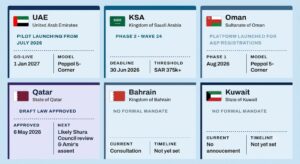 E-Invoicing Rollout Across the GCC: Evolving Compliance Landscape – June 2026 Update
Electronic invoicing requirements are being progressively introduced across the Gulf Cooperation Council (GCC), with each jurisdiction advancing at its own pace and adopting distinct implementation models, timelines, and technical specifications.
Saudi Arabia is already operating a mature e-invoicing system and is currently progressing through the advanced stages of Phase 2 integration. The United Arab Emirates and Oman have both published structured rollout timelines, with implementation expected to be phased and initially focused on larger taxpayers. Qatar has initiated early legislative steps toward adoption, while Bahrain remains in the consultation phase without a confirmed implementation schedule. Kuwait has not yet formally announced its approach. Despite these differences, the overall regional direction clearly indicates a transition toward mandatory digital invoicing across all GCC jurisdictions.
The variation in readiness levels, system architecture, and enforcement mechanisms across the region creates a complex compliance environment, particularly for multinational and regionally active businesses operating in multiple GCC countries simultaneously.
GCC E-Invoicing Overview
A comprehensive GCC E-Invoicing Alert has been developed to provide a structured overview of the current landscape across all six GCC jurisdictions. It covers:
- Comparative status of e-invoicing implementation by country
- Expected launch timelines and phased rollout plans
- Technical frameworks and system design approaches
- Penalty regimes and enforcement measures for non-compliance
- Key operational and compliance considerations for businesses
Supporting Businesses Through Implementation
Corporate Group supports organisations across the full e-invoicing lifecycle, including:
- Assessment of readiness and identification of compliance gaps
- VAT compliance health checks and process reviews
- Master data structuring and process optimisation
- User acceptance testing (UAT) and change management support
- Selection of accredited service providers and solution partners
- Full implementation planning and project management support
Conclusion
As GCC jurisdictions continue to develop and refine their e-invoicing frameworks, businesses are required to navigate increasingly diverse regulatory and technical requirements. Early preparation and coordinated regional planning are becoming essential for ensuring compliance and operational continuity.
For further guidance on e-invoicing developments across the GCC or to assess your organisation’s readiness, you may contact:
Corporate Group Advisory Team
 Saudi Arabia VAT Refund Claims for Non-Resident Businesses – June 2026 Deadline
Non-resident businesses that incurred Value Added Tax (VAT) in the Kingdom of Saudi Arabia (KSA) during the 2025 tax year should assess their eligibility and ensure that any refund applications are submitted to the Zakat, Tax and Customs Authority (ZATCA) no later than 30 June 2026.
Eligibility Requirements
To be considered for a VAT refund, a non-resident entity must generally satisfy the following conditions:
- No permanent establishment or fixed place of business in Saudi Arabia
- Registered for VAT or an equivalent indirect tax in its country of establishment
- Located in a jurisdiction that provides reciprocal VAT refund treatment for GCC entities
Only input VAT incurred on eligible business-related expenses during 2025 is recoverable. Certain categories of expenditure—such as entertainment, private use, and other restricted costs—are not eligible for refund.
The appointment of a fiscal representative in Saudi Arabia is also a mandatory requirement for non-resident applicants.
Documentation and Filing Requirements
Refund applications must be submitted through ZATCA’s electronic system and are generally required to include:
- Valid VAT-compliant tax invoices
- Proof of payment supporting the transactions
- Additional supporting evidence such as reciprocity confirmation, foreign tax registration documents, and commercial registration details
If the tax authority requests further information, applicants must respond within the stipulated deadlines. Failure to provide the required documentation in time may result in rejection of the claim.
Key Practical Considerations
From practical experience across GCC VAT refund processes, common issues that arise include:
- Correct interpretation of eligibility under reciprocity rules
- Ensuring invoice compliance with Saudi VAT requirements
- Availability and accuracy of payment proof
- Completeness of supporting documentation for audit purposes
Support from Corporate Group
Corporate Group assists businesses throughout the VAT refund process, including:
- Eligibility evaluation for non-resident refund claims
- Assistance with taxpayer registration requirements
- Detailed review of invoices and supporting documents
- Preparation and submission of refund applications
- Follow-up and communication with tax authorities
Conclusion
Given the strict compliance requirements and fixed submission deadline, businesses are advised to begin preparing their refund claims early to avoid delays or potential rejection.
For assistance in assessing eligibility or preparing a VAT refund claim in Saudi Arabia, please contact:
Corporate Group Advisory Team

GCC–UK Free Trade Agreement Finalised: Key Developments and Business Implications – June 2026 Update
On 20 May 2026, the Gulf Cooperation Council (GCC) and the United Kingdom (UK) formally concluded negotiations on a landmark Free Trade Agreement (FTA) through a Joint Statement signed in London. This makes the UK the first G7 economy to reach a comprehensive trade agreement with the GCC, following four years of negotiations. The agreement covers all six GCC member states: Saudi Arabia, the United Arab Emirates, Qatar, Kuwait, Bahrain, and Oman.
The deal is expected to significantly deepen economic ties, with projections indicating an approximate 19.8% increase in bilateral trade flows and an estimated additional USD 20.8 billion in annual trade activity. Once fully implemented, tariffs on UK exports to the GCC—valued at around USD 777 million annually—will be eliminated, including immediate duty savings of approximately USD 482 million from the date the agreement enters into force.
Sectoral Coverage and Scope of Cooperation
The FTA extends well beyond tariff reduction, establishing a broad framework for cooperation across several strategic sectors, including:
- Food and agricultural products
- Medical and healthcare equipment
- Advanced manufacturing industries
- Digital economy, artificial intelligence, and emerging technologies
- Clean and renewable energy sectors
The agreement also introduces enhanced commitments in digital trade, particularly around cross-border data flows, alongside improved access for service providers operating in consulting, engineering, legal, and financial services.
In addition, customs procedures are expected to become more efficient, with an ambition for standard goods to clear within 48 hours and perishable goods within 6 hours, subject to compliance with customs requirements.
Rules of Origin: Key Commercial Considerations
A central feature of the agreement is the rules of origin framework, which determines eligibility for preferential tariff treatment. Only goods that are either wholly produced or substantially transformed within the UK or the GCC will qualify.
Importantly, the structure allows continued use of third-country inputs without automatically disqualifying goods from preferential treatment, provided the final product meets the required transformation criteria. This is particularly relevant for industries such as automotive, chemicals, machinery, and electronics, where global supply chains remain integral.
Another notable feature is the introduction of self-certification mechanisms for UK exporters after initial registration, reducing administrative burden and supporting smaller businesses in accessing GCC markets more easily.
The agreement also includes verification procedures to ensure compliance with origin requirements and to safeguard the integrity of preferential tariff access.
Customs Facilitation and Trade Efficiency Measures
The customs and trade facilitation chapter introduces several reforms aimed at reducing administrative friction and improving predictability for traders, including:
- Digital-first customs processes with simplified data requirements
- Transparency obligations requiring online publication of customs procedures in accessible formats
- Targeted clearance timelines of 48 hours for general goods and 6 hours for perishable items, where inspection is not required
- Access to advance rulings on classification, valuation, and origin, with decisions expected within 90 days
These measures are designed to enhance certainty for businesses engaged in cross-border trade between both regions.
Tax and Investment Implications
The agreement is expected to have wide-ranging implications for taxation and investment planning across both regions:
Indirect tax considerations:
Businesses will need to assess how the FTA interacts with existing VAT systems in the GCC, particularly in relation to imports, export treatment, and new service-based transactions arising from improved market access.
Customs duty optimisation:
The removal of tariffs on qualifying goods presents opportunities for companies to reassess sourcing strategies and supply chain structures. Proper analysis of origin qualification will be essential to fully benefit from preferential treatment.
Transfer pricing impact:
Any restructuring of supply chains or intercompany service arrangements driven by the FTA should continue to comply with arm’s length principles and be properly documented.
Investment structuring opportunities:
Enhanced access to sectors such as professional and financial services may prompt businesses to reconsider their regional operating models and assess whether existing structures remain optimal under the new trade environment.
Implementation Timeline and Next Steps
The agreement has now been concluded at the negotiation stage and formal ratification procedures will follow in both jurisdictions. Once ratification is completed, the FTA is expected to enter into force from 1 January of the year following the exchange of ratification instruments.
Further technical details, including the full legal text, are expected to be published through official government channels after ratification.
Corporate Group will continue to track developments and provide updates as the agreement progresses through its final approval stages.
Conclusion
The GCC–UK Free Trade Agreement represents a major milestone in international trade relations, creating new opportunities for cross-border commerce, investment, and supply chain optimisation. At the same time, it introduces important technical considerations that businesses will need to assess carefully to fully benefit from the agreement.
For further discussion on the implications for your business, supply chain, or investment structure, you may contact:
Corporate Group Advisory Team

GCC Global Tax and Trade Developments – May 2026 Overview
May 2026 witnessed a series of important international tax treaty approvals and trade-related agreements involving GCC jurisdictions, reflecting the region’s continued efforts to expand its global economic partnerships and strengthen cross-border tax cooperation.
Bahrain – Ratification of Tax Treaty with Jersey
On 17 May 2026, Bahrain enacted Law No. 18/2026, formally ratifying the Income Tax Treaty between Bahrain and Jersey (signed in 2025). The agreement is intended to enhance investment flows between the two jurisdictions and provide greater clarity on the allocation of taxing rights, thereby reducing uncertainty for cross-border taxpayers.
Burundi – Progress on Tax Treaty with the UAE
On 21 May 2026, the Senate of Burundi approved the Income Tax Treaty with the United Arab Emirates (originally signed in 2017). Once fully ratified, the treaty is expected to support stronger economic cooperation between both countries while introducing mechanisms to avoid double taxation and address tax avoidance risks.
Iraq – Approval of Tax Treaty with Oman
On 25 May 2026, Iraq’s Council of Ministers approved the Income and Capital Tax Treaty with Oman (2025). The agreement is designed to deepen economic relations between the two countries and provide enhanced tax certainty for investors and businesses operating across both jurisdictions.
Kazakhstan – Senate Approval of Treaty with Oman
On 28 May 2026, the Senate of Kazakhstan approved the Income and Capital Tax Treaty with Oman (2025). This development represents another step in Oman’s ongoing expansion of its tax treaty network and supports broader economic and investment ties with key international partners.
Russia – Ratification of UAE Trade Agreements
On 25 May 2026, Russia ratified the Economic Partnership Agreement between the Eurasian Economic Union (EAEU) and the United Arab Emirates, originally signed on 27 June 2025. The agreement covers Armenia, Belarus, Kazakhstan, Kyrgyzstan, and Russia, and is expected to enhance trade flows, investment activity, and broader economic cooperation between the UAE and the EAEU bloc.
In addition, Russia also ratified the Agreement on Trade in Services and Investment with the UAE, signed on 7 August 2025. This agreement focuses on improving market access and strengthening cooperation across key service sectors, while encouraging increased investment flows between both sides.
Regional Outlook
These developments highlight the continued expansion of the GCC’s international tax treaty network and trade agreements. The region is steadily strengthening its global economic integration through enhanced treaty coverage, investment facilitation measures, and broader trade liberalisation initiatives.
Collectively, these agreements reinforce the GCC’s growing role as a globally connected economic hub, supported by ongoing improvements in tax cooperation frameworks and cross-border regulatory alignment.

Monthly GCC Customs Corner – Kuwait Customs Developments (June 2026 Update)
Kuwait has issued a series of customs circulars in 2026 introducing key regulatory updates across export controls, import procedures, digital payment mechanisms, and trade facilitation measures. These developments reflect a broader effort to modernise customs administration while balancing regulatory control, supply chain efficiency, and revenue collection.
Export Restrictions on Subsidised Essential Goods
Customs Circular No. (21) of 2026 implements Ministerial Decision No. (30) of 2026 concerning additional cost support for essential commodities.
Under this circular, the export of subsidised basic food and consumer goods outside Kuwait is prohibited unless prior ministerial approval is obtained. The restricted items include staple food products such as rice, flour, lentils, vegetable oils, and sugar, as well as frozen poultry, tomato paste, infant milk products, powdered milk, canned goods (including legumes, tuna, corn, and beans), and bottled water.
The measure is effective immediately upon issuance and remains applicable until 30 June 2026. It reinforces Kuwait’s policy of ensuring domestic price stability and safeguarding the availability of essential goods within the local market.
Updated Import Procedures for Satellite Devices, Drones, and Aircraft
Customs Circular No. (22) of 2026 introduces revised import procedures for satellite communication devices (including Starlink and Thuraya systems), drones, and aircraft.
This update replaces Circular No. (49) of 2025 following confirmation from the Communications and Information Technology Regulatory Authority (CITRA) that satellite internet services have been licensed in Kuwait and associated devices have been officially approved.
The circular also assigns coordination responsibilities to the General Administration of Security Systems under the Ministry of Interior for release procedures involving such devices. Imports must be routed through the automated customs system or processed manually where necessary, and supported by documentation including the importer’s civil ID, invoice, customs reference number, and declaration details. Similar requirements apply to drones and aircraft shipments.
Issued on 30 April 2026, the circular aligns customs controls with the formal licensing of satellite services while maintaining enhanced security oversight for sensitive equipment.
Shift to Electronic Collection of Stamp Duties
Customs Circular No. (23) of 2026 introduces a revised mechanism for the collection of stamp duties on customs declarations and deposit/export documentation.
Following the discontinuation of electronic stamp usage for customs-related transactions, applicable fees will now be collected through approved electronic payment channels and point-of-sale systems, with revenues directed to the General Administration of Customs.
Issued on 10 May 2026, the new mechanism takes effect five days after publication in the Official Gazette. The change reflects a broader shift toward streamlined digital revenue collection and simplified administrative processes.
Introduction of Pre-Clearance for Land Port Imports
Customs Circular No. (24) of 2026 establishes a pre-clearance system for goods arriving through land border points.
Importers and authorised representatives are now permitted to submit customs declarations in advance via the automated system before the physical arrival of goods. If the goods do not arrive within 30 days of submission, the declaration will be automatically cancelled. Traditional clearance procedures remain available as an alternative.
The circular, issued on 12 May 2026, includes a procedural guide outlining applicable requirements. The initiative is designed to reduce congestion at land ports, accelerate clearance times, and improve overall logistics efficiency while maintaining customs oversight.
GCC Authorised Economic Operator (AEO) Clearance Guidelines
Customs Circular No. (25) of 2026 introduces updated procedures for companies holding GCC Authorised Economic Operator (AEO) status when exporting to GCC member states.
Under the new framework, AEO-certified companies must communicate their identification code (such as a GCC AEO certificate number) to importing parties. This reference must be included in the customs declaration submitted through the automated system.
Upon arrival at customs checkpoints, shipments linked to AEO entities are directed to fast-track clearance lanes, enabling expedited processing. A bilingual operational guide has been issued alongside the circular.
Issued on 17 May 2026, the update strengthens the linkage between AEO certification and preferential customs treatment, enhancing facilitation for compliant traders.
Conclusion
These recent circulars demonstrate Kuwait’s continued evolution toward a more structured, digitised, and security-conscious customs environment. While trade facilitation measures such as pre-clearance and AEO fast lanes improve efficiency, parallel controls ensure regulatory oversight and domestic supply protection.
For further discussion on how these developments may impact your operations, you may contact:
Corporate Group Advisory Team